
Potter TDCJ Release Paths
TDCJ is the statewide prison, state-jail, transfer, and release system. It is not Potter County Detention Center. A Potter defendant marked “sentenced TDCJ” on the county roster may be waiting for transfer into state custody. The person has left local custody only when PCSO records the transfer, and has not left confinement merely because the county roster later drops the name.
A later state departure can be parole, mandatory supervision, full discharge, transfer, bench-warrant movement, or another authorized movement. Parole and mandatory supervision release a person from prison into legal supervision. Discharge ordinarily means the sentence and related supervision obligation have ended. A transfer between units is continued state custody.
William P. Clements Unit in Potter County is a TDCJ prison and regional release site. A person can physically leave from Clements after a sentence originating anywhere in Texas. That event remains a TDCJ release, not a Potter County jail release.
Confirm a Potter TDCJ Release
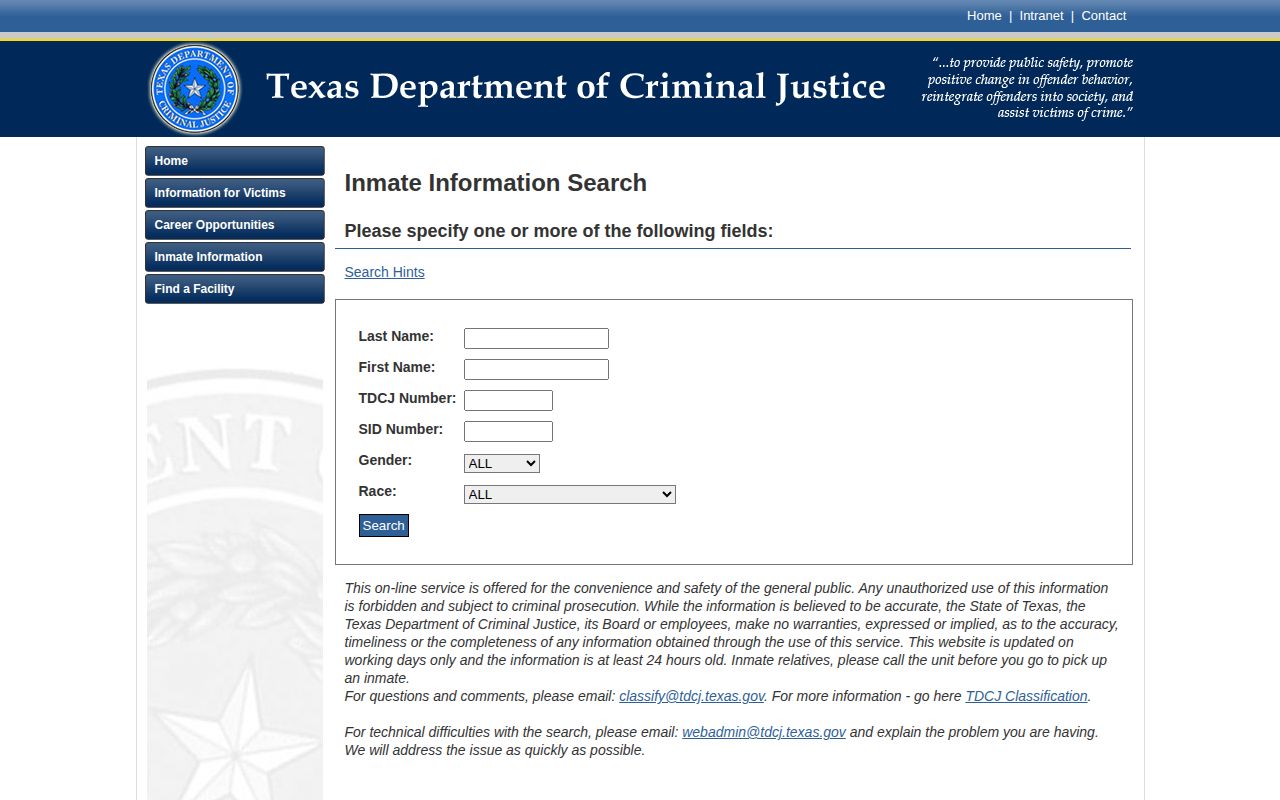
Use the statewide record while the person is incarcerated, then move to TDCJ information, records, IVSS, or Parole Division status after the current search stops returning the record.
- Open the TDCJ Inmate Information Search.
- Search by TDCJ number or SID when known; otherwise match name with offense and sentence details.
- Read facility, current status, projected release, parole eligibility, and maximum sentence fields separately.
- Record the date of access because TDCJ says public information is at least 24 hours old and updates on working days.
- Check TDCJ IVSS for available custody, parole, release, or discharge notifications.
- Request actual release date, release type, release unit, and supervision or discharge status from TDCJ when the former record is absent or unclear.
A “no result” in the current-prisoner search is not proof of release. It can require a former-inmate records route. Likewise, a projected or scheduled date does not establish that the person crossed the release point.
Potter TDCJ Search Fields
The public detail uses state identifiers and prospective fields. Availability varies with status and record, so a missing field should not be supplied from guesswork.
| Field | Meaning |
|---|---|
| TDCJ number | The state corrections identifier used for the commitment. |
| SID number | A Texas criminal-history identifier that helps match records. |
| Current facility and status | The reported state location and custody posture. |
| Projected release date | TDCJ’s estimate if parole does not occur earlier. |
| Parole eligibility date | The threshold for review, not an approval or exit date. |
| Maximum sentence date | The endpoint shown by the governing sentence record. |
| Scheduled release date and site | A later processing stage that can still change. |
| Actual release type and date | The completed state event sought through current information or records. |
Offense, sentence, and county fields help distinguish people with similar names. Compare them to the Potter judgment. Do not use a projected field to describe a past release.
Potter TDCJ Date Hierarchy
TDCJ defines Projected Release Date as the Classification and Records estimate for release from incarceration if parole does not happen sooner. Scheduled Release Date and Scheduled Release Location appear after approval, audit, and placement on a release schedule. Even a scheduled date can change without notice, including on the expected day.
- Eligibility
- The legal point when review may occur.
- Projection
- A calculation based on current sentence and credit data.
- Schedule
- An approved action that has advanced through audit and logistics.
- Actual release
- The dated prison-exit event and legal type.
- Discharge
- The later end of sentence and supervision when applicable.
Release processing can involve certificate review, calculation, placement, program completion, and hold checks. General processing estimates are not guarantees. New legal process or corrected records can intervene.
Texas Good Time and Release
Texas Government Code Chapter 498 governs classification and good-conduct time. Section 498.003 authorizes qualifying time-earning classifications and credits. Section 498.004 covers forfeiture and possible restoration. Section 498.005 provides the key limit: good-conduct time affects eligibility for parole or mandatory supervision and does not otherwise reduce the sentence itself.
For ordinary eligible cases, Government Code §508.145(f) generally uses calendar time plus accrued good time equaling one-fourth of the sentence or 15 years, whichever is less, subject to Chapter 508. Listed aggravated or deadly-weapon cases under §508.145(d) generally require one-half actual calendar time or 30 years, whichever is less, with a two-year minimum. Other subsections create different rules or ineligibility.
Texas has no blanket rule that every state prisoner serves 85 percent. Offense date, offense, enhancement, sentence structure, release mode, and mandatory-supervision exclusions matter. A universal percentage calculator would be inaccurate.
Potter Parole and Discharge
The Texas Board of Pardons and Paroles decides parole and mandatory-supervision cases, while the TDCJ Parole Division administers supervision. Ordinary parole review is a file-voting process rather than a public courtroom hearing. Eligibility marks when review may occur, not the likely result.
Approval codes can require future dates, transfer, or program completion before release. Denial codes can set another review or require service of the remaining term. Approval can also be withdrawn when new information appears. Therefore a vote is a decision milestone, not the physical release record.
Potter supervision maps to the Amarillo District Parole Office at 5809 South Western Street, Suite 120, Amarillo, TX 79110, (806) 355-9218. The Amarillo Board office is separately in Suite 200. The District Parole Office handles supervision; the Board office handles review correspondence and decisions. Full discharge should be confirmed through the responsible state status or record.
TDCJ Records and Clements Contact
Send a focused public-information request through the TDCJ Public Information Act channel. Identify full name, TDCJ number, SID, and the requested release fields. Ask for actual release date, release type, release unit, and supervision or discharge status. A broad institutional file can contain confidential material and lead to redaction or cost, so request the needed release evidence.
9601 Spur 591
Amarillo, TX 79107-9606
(806) 381-7080
Unit code BC
Clements is a facility contact, not the general former-inmate records channel. Its official page lists male custody, multiple custody grades, security detention, specialized mental-health custody, capacity of 3,182, and regional release-site operations. Use TDCJ statewide records for the release type and status.
Potter County Versus TDCJ
The Potter jail record and TDCJ record meet at transfer. PCSO can establish the local release or transfer time and receiving agency. TDCJ establishes state reception, incarceration, projection, parole action, release, and discharge. Neither system should be made to answer for the other.
If PCSO’s active report shows a TDCJ sentence, note the SO and booking numbers and request the transfer event. Then search TDCJ with the state identifier after reception. A delay between systems is possible. Save dated copies and avoid treating roster disappearance as proof of community release.
After state release, IVSS and Parole Division records can establish whether supervision continues. A court judgment may explain the sentence, but TDCJ’s executed release record establishes the state event. This custody-owner sequence keeps a Potter County case connected without turning TDCJ into a county jail.
Request a Potter TDCJ Record
A precise request reduces delay and needless redaction. Give the full name, TDCJ number, SID, date of birth if known, and approximate commitment or release period. Ask for actual release date, legal release type, release unit, scheduled location if relevant, and whether parole, mandatory supervision, or discharge followed.
Do not request a broad pen packet unless the entire institutional file is needed. Such files can contain confidential, medical, security, or third-party material. A focused release-field request is easier for TDCJ to identify and price.
Texas Public Information Act cost rules can permit reproduction, labor, programming, and overhead charges in qualifying cases. Respond to clarification or a cost estimate promptly. TDCJ may redact protected material while releasing segregable public information.
Why Potter TDCJ Dates Change
Projected and scheduled fields can move after corrected jail credit, sentence stacking, concurrent-versus-consecutive clarification, good-time earning or forfeiture, a Board vote, program requirements, an unapproved plan, a detainer, bench warrant, new legal process, medical issue, or audit.
Label every displayed date by type and access date. If a planned date passes without a confirmed event, ask TDCJ rather than assuming release occurred. Actual evidence must come from the responsible state record.