
Potter Federal Release Systems
Federal custody is a network, not a named Potter County correctional institution. A person prosecuted federally may never appear in a Potter criminal court. Another person may spend time at Potter County Detention Center on a federal hold, writ, or contract arrangement before moving elsewhere. The county roster can describe the local hold, but PCSO does not control the later federal record.
The agency split matters. USMS manages federal pretrial prisoners and transportation. BOP generally becomes the long-term locator after federal sentencing and keeps online records for federal prisoners from 1982 to the present. U.S. Probation administers supervised release ordered by the sentencing court after incarceration. Those three roles should not be collapsed.
| Stage | Primary source | What it can establish |
|---|---|---|
| Potter jail hold | PCSO release or transfer entry | When county custody ended |
| Federal pretrial custody | USMS, docket, counsel, holding jail | Placement or movement |
| Sentenced custody | BOP locator and records | Facility, status, release date |
| Supervised release | Federal court and U.S. Probation | Post-custody supervision |
Search Federal Release Records
Use the BOP Inmate Locator with the register number whenever known. Numeric searches can use BOP, FBI, INS, or DCDC identifiers supported by the form. A name search uses name and narrowing details such as race, sex, and age. Compare the complete identity and never rely on a common name alone.
A released BOP entry may show a release date with “Released” or indicate that the person is not in BOP custody. Read the exact label. BOP warns that sentence calculations can change, and a projected date is not proof that physical release occurred. “Not in BOP custody” can also reflect another authority, a different custody stage, or a record-scope issue. Cross-check the sentencing docket or obtain BOP confirmation when release type matters.
- Find the register number in court or prior custody records.
- Search and match all available identifiers.
- Record the displayed status, date, and lookup date.
- Compare the federal judgment and docket.
- Request BOP records if the public label is unclear.
BOP Locator Release Screen
The official BOP locator is the mapped federal source for Potter County release research.
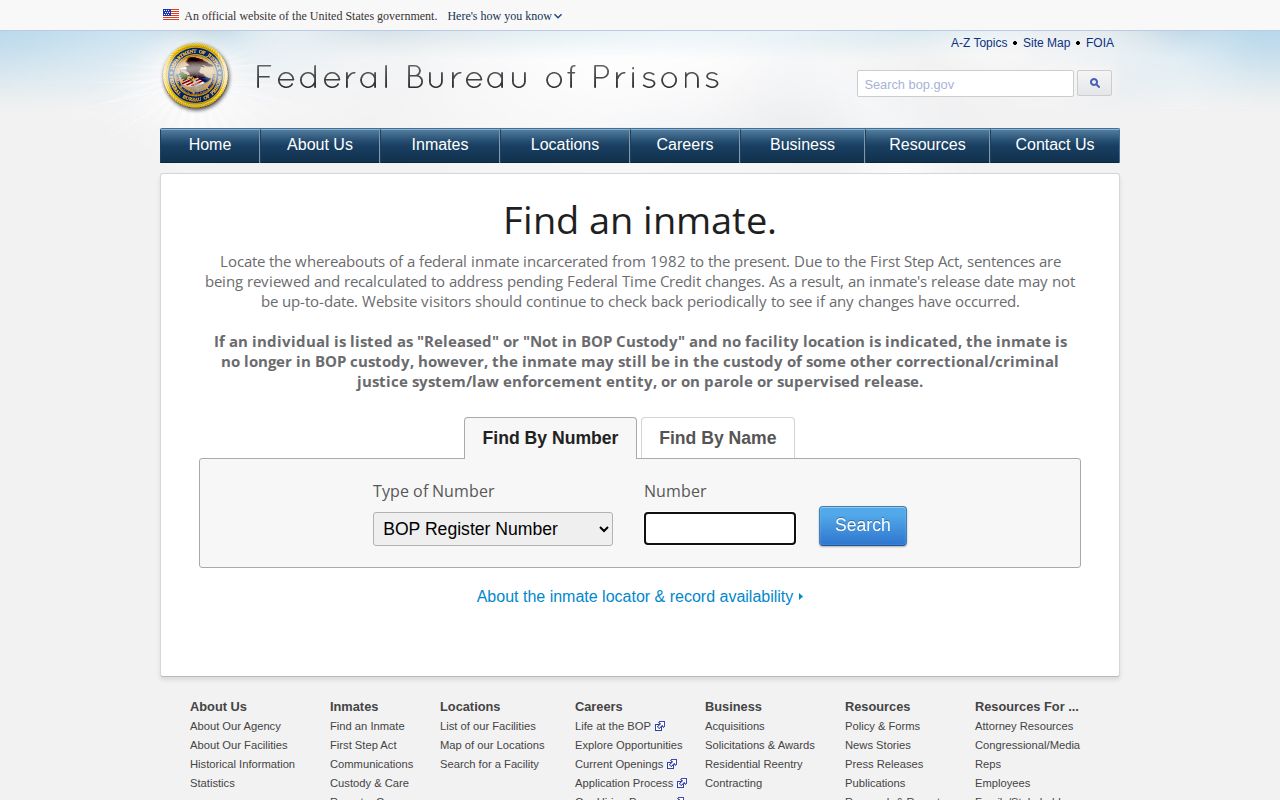
The search form is useful for sentenced federal custody and historical release dates. It is not a public USMS pretrial roster and does not document a Potter County jail release.
Potter County Federal Transfers
Start with PCSO when a Potter roster or known booking connects the person to the county jail. The Sheriff’s records hub provides a dated active roster and daily book-in report, not a historical release list. Note the booking and SO numbers, then ask Records for the physical departure date and time, release type, authority, and receiving agency.
PCSO Records is at 13103 NE 29th Avenue, Amarillo, TX 79111, and uses (806) 379-2932. Published hours are Monday through Friday, 8:00 a.m. to 4:00 p.m. PCSO says an in-person requester completes a form and presents picture identification. If the entry says federal or names USMS, describe the event as release from Potter County custody to federal custody.
A local charge dismissal or bond does not clear a separate federal hold. Review every line attached to the booking. The county transfer record supplies the bridge to the federal search and prevents a roster disappearance from being mislabeled as community release.
USMS Pretrial Custody Route
The U.S. Marshals Service prisoner program manages federal detainee movement and detention before BOP placement. USMS often uses contract facilities. It has no public historical name-search locator equivalent to BOP. A pretrial defendant may therefore be absent from the BOP locator even while federal custody continues.
Use the Northern District of Texas docket, defense counsel, the known holding facility, or the appropriate USMS district office. Provide the federal case number and full identifying information. Court entries can document initial appearance, detention, release conditions, sentencing, writs, or transfer, but operational location may lag or be restricted.
Do not infer community release from “not found” at BOP. The person may be pretrial, moving under USMS, held under another name format, housed by contract, or not yet received into the sentenced BOP population. Confirm the custody stage first.
Federal Court Release Evidence
The federal docket is the enduring legal record. A detention order, conditions-of-release order, judgment, sentence, revocation, or dismissal can explain why custody changed. PACER and the clerk for the correct federal district are the normal record paths. Potter County’s Tyler portal does not replace a federal docket.
A court order still differs from the physical exit event. Processing, another warrant, immigration action, or state custody may delay or redirect departure. Pair the signed federal order with BOP, USMS, or holding-facility confirmation. When a person was temporarily in Potter County jail, add the PCSO transfer timestamp.
- Pretrial release
- Release under federal court conditions before judgment.
- Sentence completion
- End of the custodial term as calculated by BOP.
- Supervised release
- Court-ordered community supervision after incarceration.
- Transfer
- Movement between custodians while detention continues.
Federal Supervised Release
Federal supervised release is not parole and is not BOP custody. A federal judge imposes it as part of the sentence, and U.S. Probation administers it after prison. The BOP release date can mark the end of physical BOP confinement while court supervision continues. The judgment states the term and conditions, while later docket entries can document modification, alleged violation, or revocation.
Texas parole belongs to TDCJ and the Texas Board of Pardons and Paroles. Potter County community supervision belongs to the local court and CSCD. Neither system verifies federal supervised release. Direct status questions through the federal case and authorized U.S. Probation channels.
Residential reentry placement can also complicate plain language. A person may move from a secure institution to a residential reentry center or home confinement while remaining in BOP legal custody. Confirm the displayed status and effective release date rather than describing every movement as full release.
Request Federal Release Records
Use BOP FOIA for agency records beyond the locator. Identify the person with full name, register number, date of birth when appropriate, sentencing court, and approximate dates. Ask narrowly for release date, release type, release institution, and destination or custody status when recorded. Federal disclosure law, privacy rules, identity verification, authorization requirements, and law-enforcement exemptions may apply.
For USMS material, direct the request to USMS under federal FOIA and recognize that operational and prisoner information can be restricted. Ask PCSO separately for its local booking and transfer record under the Texas Public Information Act. Federal agencies do not use the Texas request process.
A precise request reduces mismatches and broad-file costs. If material is withheld, ask for the cited exemption and segregable portions. Do not assume a booking photograph will accompany locator data. The BOP locator is not a mugshot gallery, and USMS policy generally limits prisoner booking-photo disclosure.
Federal Release Cross-Checks
Use two records when exact status matters. A BOP “Released” entry plus the federal judgment can verify sentenced-custody completion. A Potter transfer entry plus a later federal docket event can establish continued federal custody. A BOP date plus a supervised-release docket can show that prison ended while supervision began.
Record the source and “as of” date. Search failures can result from name variation, old records before the locator’s 1982 scope, pretrial status, another sovereign, data delay, or system downtime. Never convert no result into proof of release.
| Observed result | Safe next step |
|---|---|
| BOP says Released | Confirm date and court status |
| No BOP result | Check USMS stage and docket |
| PCSO says federal transfer | Follow named receiving agency |
| Projected BOP date | Wait for actual status or record |
Federal Release After Potter
A complete federal chain can begin with an APD arrest or Potter booking, continue through a USMS hold, move into BOP after sentencing, and end with BOP release followed by U.S. Probation. Another person may enter federal custody without any Potter jail episode. Search only the systems supported by the case facts.
The final description should be exact: transferred from Potter County to USMS, released from BOP on the recorded date, moved to residential reentry custody, released under federal court conditions, or began supervised release. These phrases answer different questions. The Release Date Lookup helps separate projected and actual dates.
No Potter County office can certify the entire federal history. PCSO can certify its own departure. BOP can address its sentenced custody. USMS and the holding facility address pretrial movement. The federal court supplies legal orders. That owner-by-owner method produces a defensible release conclusion.
Search Public Records
Sponsored Results