
Potter Courts Do Not Release
A court supplies legal authority. A jail or prison carries out the physical movement. Potter County’s court systems can show bond, plea, dismissal, judgment, sentence, jail credit, revocation, warrant activity, or an order affecting custody. A terse docket entry may explain the basis for release without recording when corrections staff completed the process.
Potter County Detention Center records the local physical release or transfer. If a judgment sends a person to TDCJ, leaving the county jail is a transfer into state custody. If another county, federal authority, or immigration agency has a hold, the local case may end while custody continues. Ask PCSO for the destination and receiving agency before describing a court result as community release.
The distinction protects accuracy. “Case dismissed” removes one legal basis, but another cause can remain. “Time served” credits confinement toward a sentence, yet another hold can block exit. “Sentenced TDCJ” means the state path follows, not that the person is free.
Confirm Potter Court Release Records
Begin with the exact court. Potter County explains that the District Clerk maintains district matters, the County Clerk maintains County Courts at Law and constitutional county-court matters, and each justice court keeps its own files. Amarillo Municipal Court handles city ordinance and Class C cases.
- Search the Potter County Tyler portal by name for basic county or district case information.
- Match cause number, court, filing date, and date of birth where publicly available.
- Read docket labels as leads, then request the signed bond order, dismissal, judgment, sentence, or jail-credit finding from the clerk.
- For a city case, use the Amarillo Municipal Court docket and its records contact.
- Ask PCSO Records for the booking-specific physical release date, time, type, authority, and destination.
- If the destination is TDCJ or another custodian, confirm the next status in that agency’s system.
The portal is an index and access point, not a substitute for every filed document. A certified copy from the court of record is more useful when sentence terms or release authority are disputed. The jail event closes the timing gap.
Potter Court Record Fields
Court and custody records answer different parts of the same question. Preserve both sets of identifiers so the clerk and Sheriff can match the episode.
| Record field | What it establishes |
|---|---|
| Cause number and court | The exact legal case and record custodian. |
| Bond order | The court’s release conditions, not proof that all holds cleared. |
| Plea or dismissal | A legal disposition that may remove one custody basis. |
| Judgment and sentence | The term, offense, and court-ordered custody framework. |
| Jail-credit finding | Time the sentencing record directs the custodian to credit. |
| Revocation or warrant | Later process that may restore or continue custody. |
| Jail release time and type | The physical PCSO event, found in the jail record rather than the docket. |
Search by name only to locate candidates. Similar names, multiple causes, and cross-county Amarillo arrests make cause and booking numbers important. One person can have a municipal matter, county misdemeanor, district felony, and outside hold at the same time.
Potter Court Records Contacts
The Potter County Clerk handles county-court records from 500 South Fillmore Street, Suite 201, Amarillo, TX 79101. Official Public Records and Marriage can be reached at (806) 379-2275, while the Court Department uses (806) 379-2284. The fax number is (806) 379-2296. Use the office holding the particular cause.
201 SE 4th Avenue
Amarillo, TX 79101
(806) 378-3082
citycourt@amarillo.gov
Monday through Friday, 8:00 a.m. to 5:00 p.m.
Potter County’s general open-records address at the courthouse and Commissioners Court request channel do not replace the clerk for court files or PCSO for Sheriff records. A written request must reach the proper custodian to trigger Texas Public Information Act procedures.
Request Potter Release Evidence
Request the smallest set of existing records that answers the question. From the court, identify the cause and ask for the signed custody-related order. From PCSO, identify the booking and ask for the physical release or transfer event. Do not ask either office to create a narrative or calculate a new analysis.
A purpose-neutral PCSO request should include full name, date of birth if known, SO number, booking number, approximate admission date, physical release date and time, release type and authority, charge-level disposition, and destination or receiving agency. PCSO Records is at 13103 NE 29th Avenue, Amarillo, TX 79111, (806) 379-2932, Monday through Friday, 8:00 a.m. to 4:00 p.m. The official page says an in-person form and picture ID are required.
Texas Government Code Chapter 552 permits inspection or copies subject to exceptions. Charges can include permitted reproduction, labor, programming, or overhead in qualifying cases. A commonly cited ten-business-day period concerns an agency seeking an Attorney General ruling to withhold material; it is not a universal delivery promise.
Potter Sentence Completion Proof
Sentence completion requires the judgment plus custody facts. The signed judgment supplies length, start language, concurrent or consecutive terms, and jail credit. PCSO or TDCJ applies the governing record and lawful credits. A docket label reading “time served” can authorize release, but another cause or hold may keep the person confined.
For a county sentence, request the jail time sheet, commitment, credit entries, and physical release record. For a TDCJ sentence, use the state search and request the actual release type and date from TDCJ when a former prisoner no longer appears. Projected release and parole eligibility are prospective fields, not proof of a completed event.
Probation, also called community supervision, may be ordered directly by the court instead of following prison. Parole follows release from prison and remains under state authority. Neither should be treated as full sentence discharge without the responsible record.
Potter Expunction and Nondisclosure
Texas Code of Criminal Procedure Chapter 55A governs expunction under the codification effective January 1, 2025. An expunction order can direct covered agencies to return or destroy records and remove an online trail. Eligibility depends on case history and should not be predicted from a missing search result.
An order of nondisclosure under Government Code Chapter 411 restricts public disclosure of covered criminal-history information but differs from expunction and has statutory exceptions. Juvenile and otherwise confidential records have separate protections. A lawful absence can reflect a restriction rather than a portal error.
Potter’s District Clerk publishes local expunction procedures. The researched instructions require identifying every involved agency and describe a $25 certified-mail issuance fee for each agency without an email address, with no such issuance fee when an email is supplied. That process fee is not a general court-copy or jail-record price. Legal assistance may be appropriate for eligibility and drafting.
Why Potter Courts Are Mapped
Potter County courts appear in the Facility Map because their enduring records explain release, not because they confine people. Jail roster entries disappear as reports regenerate. Court judgments and dispositions can remain accessible after the live custody display changes.
The local split is unusually important. Felony judgment, misdemeanor time-served disposition, and municipal case may sit with three different custodians. The Potter open-records page makes that division explicit. Route each request correctly, then pair the legal file with the agency that physically held the person.
The mapped court route also prevents a common mistake: equating a favorable docket entry with immediate release. Court authority, jail processing, other holds, and receiving-custodian movement are separate stages. Record them separately.
Search Potter Court Cases
The official county and district portal is the correct first screen for basic Potter case information. Narrow results to the right court and cause before requesting documents.
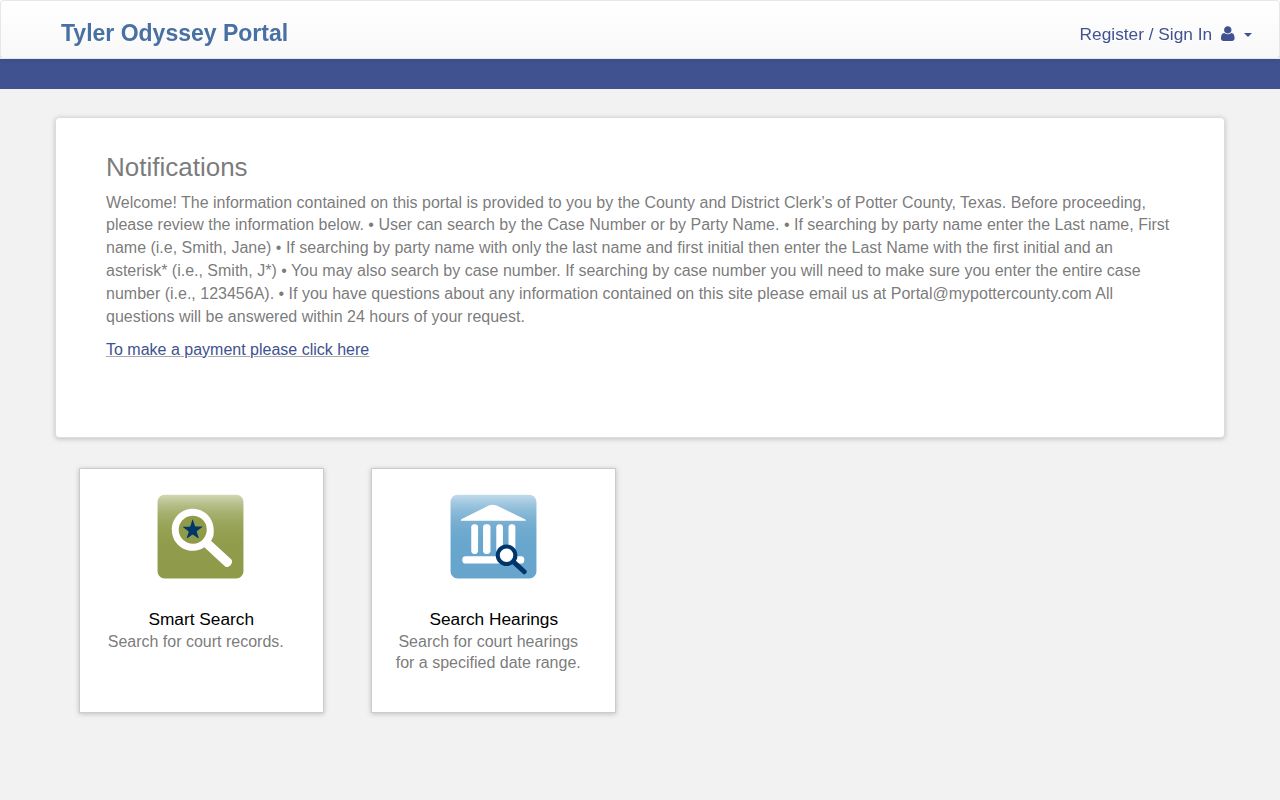
A portal entry can lag a filing or use short docket text. Contact the clerk when the result does not explain custody authority. Never infer an exact jail exit time from a case-search screen.
Reconcile Potter Court and Jail
Use a simple sequence: legal authority, jail execution, then any receiving custody. The court order identifies what should occur. PCSO records when local custody ended. TDCJ, another county, BOP, ICE, or USMS records what followed when the person did not return to the community.
Dates can differ without contradiction. An order may be signed before staff receive and verify it. A bond can post before another hold clears. A state sentence can be entered before transport. Preserve each timestamp and agency label rather than forcing the events into one release date.