
Potter Projected Versus Actual Release
TDCJ defines a Projected Release Date as the Classification and Records estimate for release from incarceration if parole does not occur first. A Scheduled Release Date and Scheduled Release Location appear later, after approval, audit, and placement on a release schedule. Even a scheduled date can change, including on the expected day. Parole eligibility only marks when review may occur. It is not approval and not an exit date.
An actual release date and type, executed release certificate, IVSS event, or Parole Division status confirms what happened. For Potter County jail custody, the corresponding proof is PCSO’s physical release or transfer entry. A pretrial detainee has no sentence endpoint to calculate. Bond, court action, dismissal, a new hold, or transfer may instead control timing.
Find Potter Release Date Fields
Start with the custodian. William P. Clements Unit is a TDCJ prison and regional release site, while the Potter County Detention Center is the county jail. A walkout at Clements remains a state release even though it occurs in Potter County.
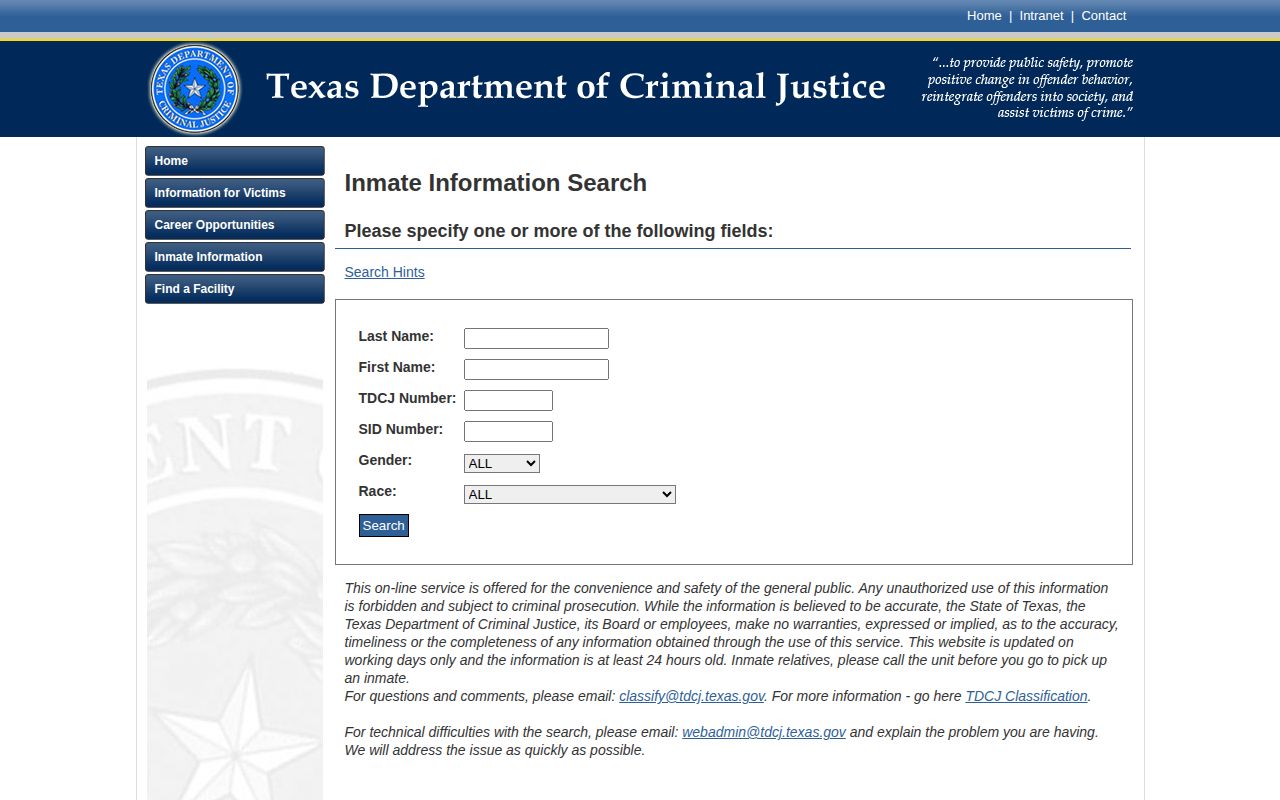
- For a state prisoner, open the TDCJ Inmate Information Search and match the TDCJ or SID number.
- Read projected release, parole eligibility, maximum sentence, facility, offense, and sentence fields as separate labels.
- Check TDCJ scheduled-release information only when release has progressed to that stage.
- For a county sentence, obtain the signed judgment, commitment, jail-credit findings, and PCSO jail time sheet.
- Ask PCSO to confirm any weekend, holiday, hold, or release-order issue. No Potter early-release formula was found.
- After the event, request physical release date, type, authority, and destination.
TDCJ says its public search is at least 24 hours old and updates on working days. Record the access date. A former prisoner may no longer appear in the current search, requiring TDCJ information, records, IVSS, or Parole Division follow-up.
Texas Good Time in Potter
Texas Government Code Chapter 498 governs classification and good-conduct time. Section 498.003 permits time-earning classifications and certain credits for diligent participation within statutory limits. Section 498.004 covers forfeiture and possible restoration. The key limit is Section 498.005: good-conduct time applies to parole or mandatory-supervision eligibility and does not otherwise shorten the judicial sentence itself.
For an ordinary eligible case, Government Code §508.145(f) generally reaches parole eligibility when calendar time plus accrued good time equals one-fourth of the sentence or 15 years, whichever is less, subject to the rest of Chapter 508. Listed aggravated or deadly-weapon cases under §508.145(d) generally use one-half actual calendar time or 30 years, whichever is less, with a two-year minimum and no good time in that calculation. Other offenses, dates, enhancements, and sentences have different rules or no eligibility.
Mandatory supervision is separate. Section 508.149 excludes listed cases, and many eligible post-1996 cases still require Board approval. State-jail-felony diligent-participation credit is a distinct judicial mechanism that may reach 20 percent in qualifying cases. It is not a universal prison formula.
Why Potter Release Dates Move
A date reflects the facts and legal records then known. TDCJ audits sentence and credit material. Release processing may also require an approved plan, program completion, placement, and a clear hold check.
| Change | Effect |
|---|---|
| Jail-credit correction | Changes the credited start or remaining calendar time. |
| Sentence clarification | Determines whether terms overlap or run consecutively. |
| Good-time earning or loss | Changes an eligible review or supervision calculation. |
| Parole decision | Approval, denial, future review, or rescission alters the path. |
| Program or release plan | Can delay scheduling until a condition or placement is complete. |
| Detainer, warrant, or case | Can block community release or route custody elsewhere. |
| Record audit | Corrects sentence, offense, or credit data before release. |
A detainer is another agency’s request to hold or notify about a person. It can turn departure from TDCJ or PCSO into a transfer. A parole grant can also require more processing, so Board approval should not be reported as physical release.
Confirm Potter Actual Release
For Potter jail custody, ask PCSO Records at (806) 379-2932 for the episode-specific physical release or transfer entry. For TDCJ custody, use TDCJ information and records, then check the Parole Division when supervision follows. The VINE Inmate Check explains how current Texas IVSS alerts can preserve a dated event. Read the type because transfer, parole release, discharge, escape, death, and court change are not interchangeable.
County courts supply the judgment and jail credit that support a county calculation. The Tyler portal offers basic Potter county and district case information, but the clerk of the court of record provides filed documents and certified copies. Amarillo Municipal Court handles city cases. Pair the court outcome with the physical release time when exact timing matters.
No Potter 85 Percent Rule
Texas has no blanket rule requiring every prisoner to serve about 85 percent of a sentence. Official statutes instead use offense-date, offense, enhancement, sentence, and release-mode rules. They include one-quarter-plus-good-time eligibility, one-half actual-time calculations for listed cases, special minimums, complete ineligibility, and mandatory-supervision exclusions.
A universal 80 or 85 percent calculator would give false answers. Use the signed judgment, offense date, TDCJ calculation, and current Government Code §508.145. Good time can affect eligibility without rewriting the sentence. This distinction matters when a projected field is mistaken for a guaranteed Potter County release date.
Potter Release Date Hierarchy
Date labels form a hierarchy of confidence. Eligibility is a legal threshold for review. A projection applies the current sentence and credit posture. Scheduling means approval, audit, and logistics have advanced, but change remains possible. Actual release or transfer is the completed event.
- Parole eligibility
- The earliest review threshold, not a promise of approval.
- Projected release
- TDCJ’s estimate if parole does not occur first.
- Scheduled release
- An action placed on a schedule after more review and audit.
- Maximum sentence date
- The endpoint shown by the governing sentence record.
- Actual release
- The dated event and type recorded by the custodian.
TDCJ processing can continue after a release certificate arrives. Audit, calculation, placement, programming, and holds may intervene. Official material gives general estimates, not guarantees. Avoid promising a Potter release within a fixed number of business days.
Potter County Jail Calculation
A county-jail sentence starts with the signed judgment. Read the sentence length, commencement language, concurrent or consecutive terms, and credit for time already confined. PCSO then applies the commitment, lawful credits, and valid jail procedure. No official Potter source reviewed publishes a weekend or holiday release formula.
Request the jail time sheet, commitment, credit entries, and physical release record. If the expected day is a weekend, contact PCSO instead of promising a Friday exit. The detention center operates every day, but Records is open on weekdays. Those facts do not establish a fixed exit hour or automatic early-release rule.
A county sentence can also be affected by another case, hold, or transfer order. Ask the record to state destination and receiving agency. Leaving Potter County Detention Center for TDCJ, another county, federal authority, or ICE ends local custody but not all custody.
Potter Parole Date Milestones
Texas parole review is a file-voting process, not an ordinary public courtroom hearing with a personal calendar. TDCJ identifies cases before eligibility, an Institutional Parole Officer prepares the file, and a three-member panel votes in sequence. Two concurring votes produce the decision. The eligibility date begins that review framework; it does not predict the vote.
Vote codes describe different next steps. FI-1 authorizes release when eligible, while FI-2 specifies a future release month or date. Other FI outcomes can require transfer or program completion. CU/NR denies release and sets a later review, CU/SA generally denies to serve all, and DMS denies mandatory supervision under the stated posture. Approval can be withdrawn or rescinded on new information.
After approval, Review and Release Processing audits and schedules the case. A release plan, program, detainer, or record correction can still intervene. The state status line and scheduled-release channel provide more current context, but the actual release event remains the final proof.
Potter Judgment Controls Calculation
The Potter court record supplies the sentence terms that a jail or TDCJ must calculate. Relevant documents include the judgment, sentence, jail-credit finding, commitment, mandate, and later revocation or correction order. A docket summary can point to those filings, but a certified copy from the court of record is stronger when terms are disputed.
Potter’s record custodians are divided by court. The District Clerk handles district matters, the County Clerk handles county-court matters, and each justice court keeps its own records. Amarillo Municipal Court handles city cases. Search by name, then verify cause number, court, filing date, and date of birth where publicly available.
If a calculation seems wrong, compare the agency field against the signed order before assuming the projected date should be changed. Send the responsible records office the exact discrepancy and supporting filing. A public search screen may lag a corrected source record.